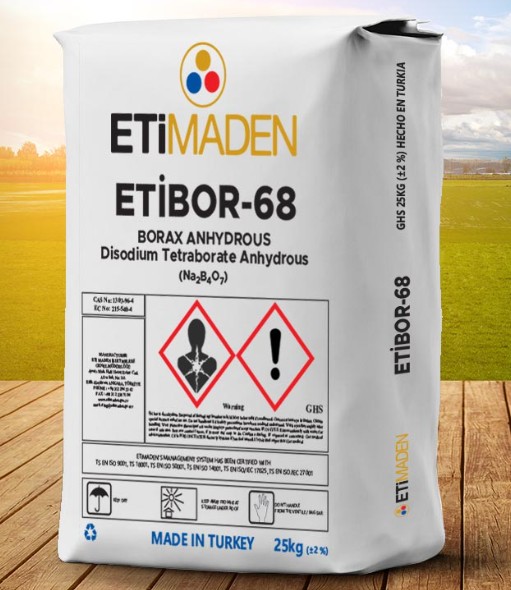
Disodium Tetraborate ETİBOR-68

Etibor-68 is produced as borate glass in large fusing furnaces as a result of the dehydration of aqueous sodium tetraborates. Na2B4O7 (anhydrous sodium tetraborate) melts at 742.5o C and creates an amorphous glassy structure when cooled rapidly.

Glass and ceramics:

Etibor-68 is used for the production of high
quality glass and ceramics. Etibor-68 is used as a B2O3 source in the
manufacturing of borosilicate glass. It is superior to borax decahydrate
and borax pentahydrate in terms of high bulk density and faster
melting with less energy. Etibor-68 reduces furnace emission and
increases production. Etibor-68 is a sodium source and can be used
together with boric acid or boron oxide in order to keep the sodium
oxide/boron oxide ratio under control. The objective for using it is to
ensure the formation of a stable structure. Nowadays, due to the
adverse effects of lead compounds against human health, particularly in kitchenware, borates which provide the same properties
(transparency, fusibility) in the glaze are preferred. To this end, boron
compounds such as anhydrous borax are preferred in the production
of glaze. The anhydrous borax, used in the glazes and enamels of the
ceramics industry, increases the chemical physical resistance of the
final product, reduces the viscosity and surface tension of the glass,
enables the glaze or the enamel to mature rapidly and provides surface
smoothness.

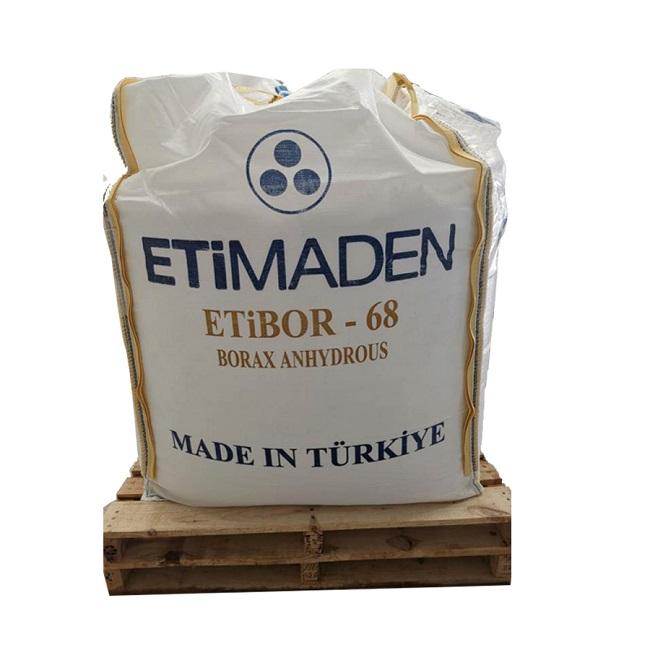
Metallurgy and casting:

Etibor-68 is used as a fusing agent. Due to its fusing properties, it dissolves metal oxide impurities by reducing the melting temperature in the production of ferrous steel and nonferrous metals, thereby facilitating the removal of impurities from the slag. Etibor-68 is a very good solvent for metal oxides at high temperatures. It prevents the oxidation of the air and the surface by covering metals. Due to its hardening properties, even a small addition to steel increases the steel’s hardness. Etibor-68 can change the properties and processing behaviors of steel materials. In metallurgy, anhydrous borax, which is primarily used as a protective slag in steel production, creates an alloy with steel at high temperatures and play the role of accelerating the fusing. Anhydrous borax, which has the effect of reducing the melting temperature of slag in gold refineries, increases the amount of fluid slag in the system at lower temperatures. Usually, anhydrous borax is used at a rate of 30-40% of the slag. It is also used to increase the strength refractory materials used in the glass, cement and aluminum industries.

Product Specification

ETiBOR-68

Anhydrous Borax — Technical Grade

Anhydrous Borax Technical Grade Rev. 2020/01
Na₂B₄O₇
Disodium Tetraborate Anhydrous
CAS # 1330-43-4
Physical Properties
Specific Weight
2.367 g/cm³
Pour (Bulk) Density
1.27 g/cm³
Molecular Weight
201.27 g/mol
Melting Point
741 °C
Boiling Point
1575 °C
Heat Capacity
6.3 J/g°C
Thermal Conductivity
0.495 W/mK
Specific Surface Area
< 1 m²/g
Diffusion Coefficient
1.1×10⁻⁵ cm²/s
Surface Tension
65.42 mN/m
Colorimetry Test
85.03 (avg L)
Solubility vs Temperature
0°C
1.05
10°C
1.65
20°C
2.54
25°C
3.15
30°C
3.95
40°C
6.32
50°C
10.66
60°C
19.86
70°C
24.80
80°C
31.63
90°C
40.39
100°C
54.44
Values in g/100g water. Saturation value at 25°C = 3.15g. Dissolution rate varies with particle size and mixing speed.
Solution pH Values (±0.1 / 25°C)
Solution (g/100g water) pH
0.19.09
0.59.02
19.02
29.02
39.00
3.15 (saturation)9.01
49.01
59.01
pH remains stable across all concentrations — ranging 9.00–9.09 at 25°C.
Solution Viscosity Values
Varying Concentration @ 20°C
Temp (°C)Conc (%)Vis (cp)
200.11.01
2011.09
2021.12
2041.18
Varying Temperature @ 4% Conc
Temp (°C)Conc (%)Vis (cp)
2041.18
4040.71
6040.48
8040.40
Varying Concentration @ 80°C
Temp (°C)Conc (%)Vis (cp)
8010.39
8040.40
80100.44
80200.51
Chemical Content
ComponentContent
B₂O₃68.30 – 69.40%
Na₂O30.41 – 30.90%
SO₄300 ppm max
Cl105 ppm max
Fe50 ppm max
Non-water solubles920 ppm max
Particle Size
SizeContent
+1.600 mm5% max
-0.075 mm5% max
Heavy Metal Content
As
< 0.010 mg/kg
Cd
< 0.005 mg/kg
Pb
< 0.010 mg/kg
Cr
< 0.005 mg/kg
Hg
< 0.010 mg/kg
All heavy metal values are below detection thresholds, confirming ETiBOR-68's suitability for sensitive industrial and specialty applications.